What would be the likely form of aliens and their biology?
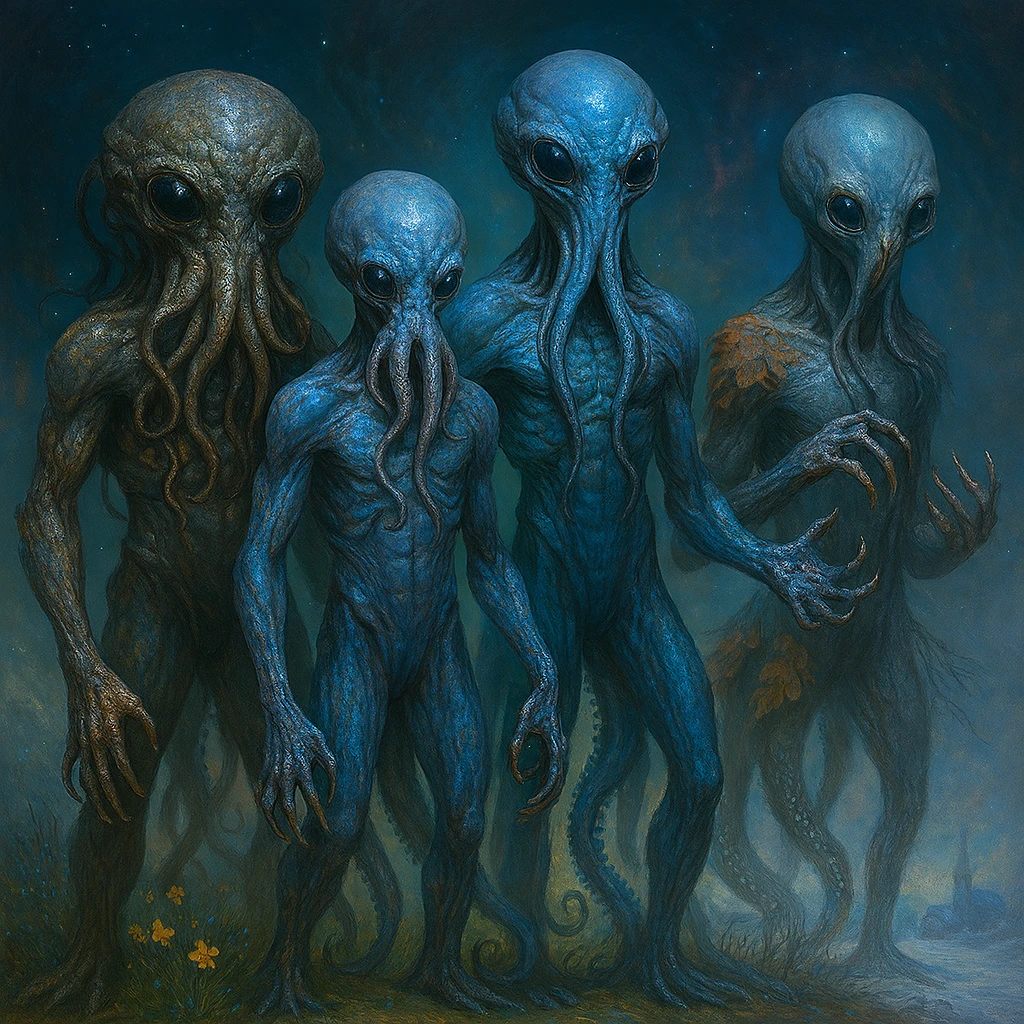
An excellent and fundamental question. Predicting alien biology is a exercise in distinguishing between universal constraints and evolutionary chance. We must use the principles of physics and chemistry as our guide, while being prepared for the astonishing diversity that evolution can produce.
Here is a breakdown of the types of biology aliens would be likely to have, structured from the most probable to the more speculative.
- The Near-Certainties: Universal Constraints
These are aspects of biology that are so tied to the laws of physics that they are likely to be convergent across the universe.
· Carbon-Based Biochemistry: Carbon is unparalleled in its ability to form the complex, stable molecules necessary for life. It forms four stable bonds, creating long chains, rings, and complex 3D structures. While science fiction explores silicon-based life, silicon is far less versatile, forms weaker bonds, and its oxides (sand) are a solid, making respiration difficult. Carbon is almost certainly the atom of life. · Liquid Solvent: Life requires a medium for molecules to move, meet, and react. Liquid water is the most probable solvent. It's abundant, has a wide liquid temperature range, is an excellent solvent, and its solid form (ice) floats, insulating liquid water below—a crucial feature for aquatic life on icy moons. Other solvents like liquid methane (on Titan) or ammonia are possible, but water's chemical advantages make it the universal favorite. · Cellular Structure: A fundamental principle of life is maintaining a distinct internal environment separate from the external one. A membrane—a barrier that can control what enters and exits—is a near-certainty. These membranes might be made of lipids (as on Earth) or other amphiphilic molecules that can form bilayers or micelles in their local solvent.
- The Very Likely: Convergent Evolution
These are solutions to common planetary challenges that evolution is likely to "discover" repeatedly. We see this on Earth, where similar forms evolve independently.
· Multicellularity: While life may begin as single-celled, the advantages of larger size and specialization of cells are immense. Multicellularity has evolved independently on Earth dozens of times (in animals, plants, fungi, red and brown algae). It is a highly probable step for complex life. · Macroscopic Size and Motility: To exploit resources and avoid becoming a resource, lifeforms will likely evolve to be larger and mobile. This implies the development of senses (to perceive the environment) and a nervous system (to process sensory information and coordinate movement). Eyes, for instance, have evolved independently over 40 times on Earth. Alien "eyes" will be a common feature on worlds with light. · Bilateral Symmetry: For motile creatures, a body plan with a distinct front (with sense organs), a back, and left-right symmetry is an efficient design for directed movement. It's a solution so effective it's likely to be widespread. · Trophic Levels (Predator/Prey): Energy flows from a source (a star, chemical vents) to primary producers (like plants or chemosynthetic bacteria) to consumers (herbivores, predators, scavengers). This ecosystem structure is a direct consequence of thermodynamics and is inevitable on any world with complex life.
- The Wild Cards: Where "Alien" Truly Begins
This is where Earthly examples end, and true speculation begins. Biology could take radically different paths depending on the planetary environment.
· Alternative Biochemistries Within Carbon-Based Life: · Handedness (Chirality): Earth life uses almost exclusively left-handed amino acids and right-handed sugars. Alien life could have the opposite preference, or even a mix, which would make Earth's organic molecules indigestible or poisonous to them (and vice-versa). · Genetic Material: DNA and RNA are brilliant, but are they unique? Aliens might use a different molecule to store genetic information—perhaps with a different backbone or nucleobase set. The information storage principle, however, is likely universal. · Alternative Blood: Instead of iron-based hemoglobin (red blood), aliens might use copper-based hemocyanin (blue blood, as in some arthropods), vanadium, or even a completely different oxygen-carrying molecule. · Body Plans Shaped by Environment: · High-Gravity World: Life would likely be stout, strong, and low to the ground. Flying might be impossible, or flight would require enormous wings. · Low-Gravity World (or a small moon): Life could be much larger and more slender. "Giraffe-like" creatures could be common. Flight might be easy, leading to diverse and large flying organisms. · Thick Atmosphere (like Titan): With dense air and low gravity, life could develop "wings" for swimming through the atmosphere as if it were an ocean. Creatures might never need to land. · Worlds Without Planetary Surfaces: Life floating in the dense atmosphere of a gas giant could resemble oceanic life—floaters, filter-feeders, and hunters of the skies. · Senses Beyond Our Comprehension: · Creatures on a world with a strong magnetic field might directly sense magnetic field lines for navigation. · Life on a tidally locked planet (one side always facing the star) might see only in infrared or have no eyes at all, relying on sonar or sensitivity to vibrations. · They might communicate and perceive their world through electrical fields (like some fish on Earth) or through chemical signals far more complex than anything we know.
The Most Profound Possibility: The Shadow Biosphere
What if life on Earth isn't the only life on Earth? A "shadow biosphere" would be a second genesis of life on our own planet, with a completely different biochemistry (e.g., using different elements or a different genetic code) that has remained undetected because we haven't known how to look for it. Finding this would be the first definitive proof that life arises easily, and the universe is likely teeming with it.
Summary Table: Likelihood of Biological Traits
Trait Probability Reasoning Example/Alternative Carbon-Based Extremely High Chemical versatility of carbon Silicon is far less likely Water Solvent Very High Abundance & unique properties Methane/ethane on Titan Cellular Very High Need for separation from environment Non-cellular life is improbable Multicellularity High Evolved many times on Earth Permanently microbial worlds Senses & Mobility High Key evolutionary advantages Sessile, planet-wide "minds" Bilateral Symmetry Moderate/High Efficient for movement Radial symmetry (like jellyfish) DNA/RNA Genetics Low A specific, albeit brilliant, solution Alternative information molecules
In conclusion, while we can be reasonably confident that alien life will be carbon-based, cellular, and subject to the pressures of evolution, its specific forms will be a breathtaking reflection of its home world's unique history and environment. The universe's biological tapestry is likely far richer and stranger than we can imagine.